
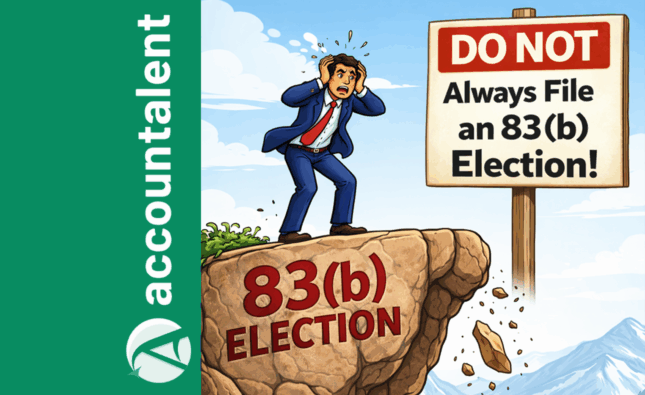
Do NOT “always” file an 83(b) Election
BAD ADVICE: “Always file an 83(b) Election”.
For 40+ years, we have heard this guidance from startup professionals.
This advice is WRONG and can be extremely costly. Here is why:
A real-life telephone call we had recently:
- Newly hired VP at a publicly traded tech company
- Granted $5M of Restricted Stock vesting over 4 years
- Paid $0 for the stock
- Timely filed an 83(b) Election
Result:He owes about $2M of taxes in Year 1
Why: An 83(b) Election tells the IRS – I want to pay taxes in Year 1 based on the difference of the FMV of the stock ($5M) less the amount paid for the stock ($0).
- Tax me now, not later.
Calculation: $5M of taxable income * 40% tax rate = $2M in taxes owed in Year 1.
(Taxed at ordinary tax rates and not capital gain rate).
A better approach with better results:
- Do NOT file the 83(b) Election
- Record taxable income as the stock vests
- Income Tax is now based on FMV at each vesting date
- Use liquidity in the public market to sell shares and pay taxes as they arise
- Example: $1.25M in stock vests in Year 1. Sell $300K of it in the public market to pay the taxes.
- Taxed at capital gain rate – a much lower rate as compared to ordinary tax rate applicable if filed an 83(b) Election.
Warning:It is close to impossible to rescind a properly filed 83(b) Election.
Even if VP quits his job and forfeits the unvested shares:
- He still owes the $2M in taxes
- No refund for taxes paid on stock that he never keeps (unvested)
Startups:
- Filing an 83(b) Election works wonderfully when your startup has just incorporated and the FMV of the stock received is $100 and you pay $100 for the stock.
- No taxes due as calculation of taxable income is $100 minus $100.
- Be VERY careful, though, when joining a later-stage startups and receiving a stock grant – things can go wrong very quickly and it can be very ugly. Get professional advice.