
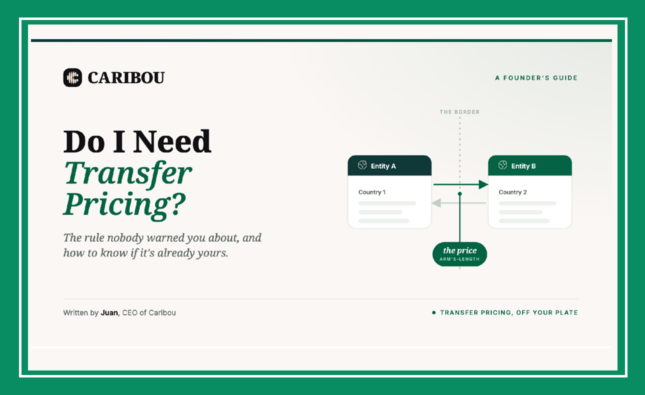
Do I Need Transfer Pricing?
A founder’s quick guide to the rule nobody warned you about
Transfer pricing sounds like a problem for multinationals and the kind of thing that needs its own tax department. That’s exactly why so many founders get caught out by it. The moment your company starts operating across two countries, it quietly becomes your problem too, and most cross that line without noticing.
So what actually is it?
Say you’ve got entities in two countries, and one does something for the other: builds the software, sells the product, lends some cash. There has to be a price on that, and transfer pricing is that price.
It isn’t entirely yours to set, though, because where you land it decides which country gets to tax which chunk of your profit. The rule is straightforward enough: price it the way you would with a complete stranger (the “arm’s-length principle”, if you want the jargon) and keep some proof that you did.
When does it kick in?
It doesn’t announce itself and no form pops up the day you open a second entity. It kicks in the moment two related companies in different countries start transacting, whichever direction that runs. A team you’ve hired abroad, revenue split across entities, or cash wired across as an “intercompany loan” with nothing written down because “we’re just moving our own money around”.
The point isn’t the specific countries. It’s that once your company straddles a border, the prices between your own entities aren’t just internal bookkeeping any more, now a tax authority gets a say.
A quick gut check
You should probably be thinking about this if any of these are you:
- You have entities in more than one country.
- Those entities transact with each other — services, IP, loans, anything.
- Your IP sits in one country and is used by another.
- Money moves between your entities with no agreement behind it.
- You’re planning to expand internationally in the next 12 months.
Tick one box and it’s a conversation worth having now rather than later.
The bottom line
None of this is scary, it’s just predictable. And predictable problems are cheap to deal with early. Putting a sensible policy in place now is simple, but unpicking two years of undocumented intercompany transactions later is a different story. The worst time to find the gap is mid-raise, with an investor’s diligence team reading your books.
Where Caribou comes in
At Caribou we help internationally-expanding companies get this right: a software-led service that handles your intercompany pricing and the compliant paperwork as you grow into new countries, instead of the one-and-done legal bill the old way charges you for.
If any of that checklist sounded familiar, you can learn more here.
Written by Juan, CEO of Caribou.